
The Indian Premier League (IPL) points table is one of the most important parts of the tournament. It shows how each team is performing during the league stage and helps fans understand which teams are moving closer to the playoffs.
But the points table is about more than wins and losses. Net Run Rate (NRR), tied points, and the number of victories can all influence a team’s final position.
If you have ever wondered why two teams with the same points appear in different positions, or why a team can qualify for the playoffs even after losing a match, this guide explains everything in simple terms.
In this article, CricRay explains how the IPL points table works, how points are awarded, how Net Run Rate is calculated, and how teams qualify for the playoffs.
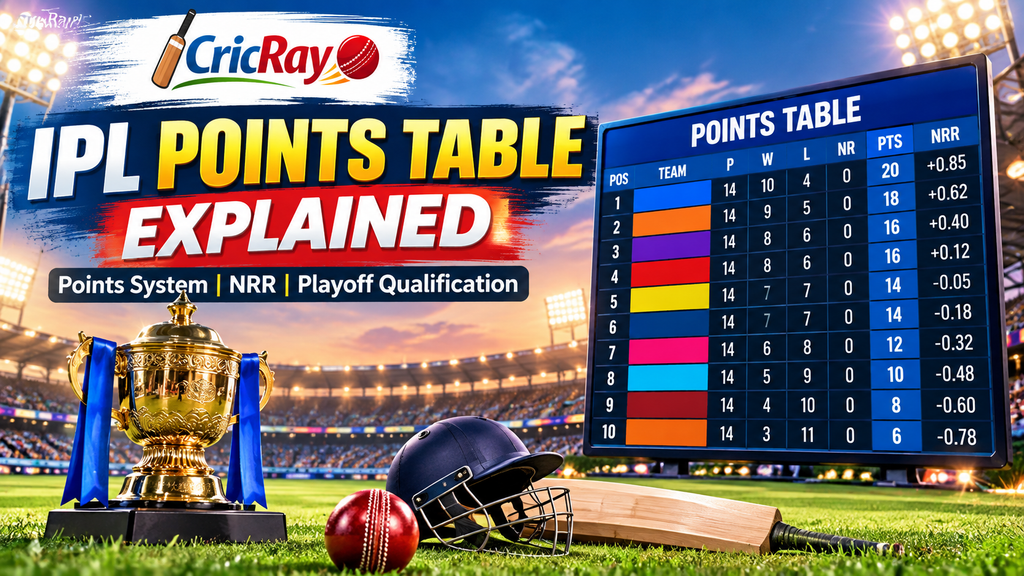
What Is the IPL Points Table?
The IPL points table is a standings chart that ranks all participating teams according to their performance during the league stage.
It usually includes the following details:
- P (Played): Total matches played.
- W (Won): Matches won.
- L (Lost): Matches lost.
- NR (No Result): Matches that ended without a result.
- Pts (Points): Total points earned.
- NRR (Net Run Rate): A measure of a team’s scoring rate compared with the scoring rate of its opponents.
Teams earn points based on match results. The table is then used to determine their positions at the end of the league stage.
In the standard IPL format, the top four teams qualify for the playoffs.
IPL Points System: How Are Points Awarded?
The IPL uses a straightforward points system during the league stage.
| Match Result | Points Awarded |
|---|---|
| Win | 2 points |
| Loss | 0 points |
| No result | 1 point per team |
| Tie with no Super Over result | 1 point per team |
A team earns two points for winning a match. A losing team receives no points.
When a match ends without a result, each team receives one point. A tied match that cannot be decided through a Super Over or subsequent Super Overs also results in one point per team under the playing conditions.
These points are added to the team’s total in the standings.
IPL Documents
+1
Example: How Points Add Up
Imagine a team plays five matches and records the following results:
| Result | Matches |
|---|---|
| Wins | 3 |
| Losses | 1 |
| No results | 1 |
The team’s total points would be:
- 3 wins × 2 points = 6 points
- 1 loss × 0 points = 0 points
- 1 no-result × 1 point = 1 point
Total: 7 points from 5 matches.
This is how the points column in the IPL table is calculated.
What Do the Columns in an IPL Points Table Mean?
When you open the IPL points table, you will see several abbreviations. Here is what each one means.
| Column | Meaning |
|---|---|
| Pos | Position in the standings |
| Team | Franchise name |
| P | Matches played |
| W | Matches won |
| L | Matches lost |
| NR | Matches with no result |
| Pts | Total points |
| NRR | Net Run Rate |
The most important columns for understanding a team’s position are Pts and NRR.
Points show how many points a team has earned, while NRR helps separate teams when their points are equal and the applicable tie-breakers require it.
What Is Net Run Rate (NRR) in IPL?
Net Run Rate, commonly known as NRR, measures the difference between a team’s average scoring rate and the average scoring rate of its opponents across the relevant league matches.
In simple terms:
- A positive NRR means the team’s average scoring rate is higher than its opponents’ average scoring rate.
- A negative NRR means the team’s average scoring rate is lower than its opponents’ average scoring rate.
NRR can become especially important when two or more teams finish the league stage with the same number of points.
Net Run Rate Formula
The basic formula is:
NRR=Overs facedTotal runs scored−Overs bowledTotal runs conceded
This represents the difference between the team’s average runs per over scored and the average runs per over conceded.
The official calculation has special provisions. For example, if a team is dismissed before using its full quota of overs, its full allotted quota is used for the relevant NRR calculation. Matches without a result generally do not count, subject to the playing conditions for adjusted results.
Simple NRR Example
Suppose a team has the following figures across its matches:
- Total runs scored: 800
- Overs faced: 100
- Total runs conceded: 750
- Overs bowled: 100
The calculation would be:
- Scoring rate: 800 ÷ 100 = 8.00
- Conceding rate: 750 ÷ 100 = 7.50
NRR = 8.00 − 7.50 = +0.50
This is a simplified example to demonstrate the formula. Actual tournament calculations depend on the official playing conditions.
How Does NRR Affect the IPL Points Table?
NRR becomes important when teams have the same number of points and the applicable tie-breaker rules move to run rate.
For example, imagine two teams finish the league stage with 16 points each.
| Team | Points | NRR |
|---|---|---|
| Team A | 16 | +0.85 |
| Team B | 16 | +0.32 |
If the teams are tied on points and wins, Team A would be placed above Team B because it has the higher NRR.
This is why teams try to win matches by healthy margins and avoid heavy defeats. A strong NRR can help a team in a close qualification race.
IPL Points Table Tie-Breaker Rules
When two or more teams finish with the same number of points, the IPL uses a set of tie-breakers to determine their positions.
For more information about team spending limits, read our IPL 2027 Salary Cap guide.
Under the 2026 playing conditions, the order is:
- Most wins: The team with more wins is placed higher.
- Higher Net Run Rate: If wins are also equal, the team with the higher NRR is placed higher.
- Wickets taken per fair ball bowled: If the points, wins and NRR are still equal, this measure is used.
- Drawing lots: If the teams remain equal after the previous criteria, their positions are determined by drawing lots.
These rules are set out in the official league-table provisions.
IPL Documents
+1
How Do Teams Qualify for the IPL Playoffs?
In the standard IPL format, the top four teams in the points table at the end of the league stage qualify for the playoffs.
The league stage determines the teams’ positions, while the playoff matches decide which team wins the championship.
Explore the IPL Winners List to see which teams have won the tournament since 2008.
The usual playoff structure includes four matches:
- Qualifier 1
- Eliminator
- Qualifier 2
- Final
IPL Playoff Format Explained
Qualifier 1
Teams finishing first and second face each other.
The winner advances directly to the final. The losing team gets another opportunity in Qualifier 2.
Eliminator
Teams finishing third and fourth face each other.
The winner advances to Qualifier 2, while the losing team is eliminated.
Qualifier 2
The loser of Qualifier 1 faces the winner of the Eliminator.
The winner advances to the final.
Final
The winners of Qualifier 1 and Qualifier 2 compete for the IPL title.
This format gives the top two teams an additional route to the final if they lose Qualifier 1.
How Many Points Are Needed to Qualify for the IPL Playoffs?
There is no fixed points total that guarantees qualification in every IPL season.
The points needed to finish in the top four depend on the results of other teams, the number of matches played, and tie-breakers such as NRR.
A team with 16 points may qualify in one season but could face a tighter race in another.
Here is a simple illustration of how points totals can affect a team’s position:
| Points Total | What It Can Mean |
|---|---|
| 20 points | A very strong league-stage record |
| 18 points | A high points total that can put a team in a strong position |
| 16 points | Can be enough, depending on other results |
| 14 points | Qualification may depend heavily on other results and tie-breakers |
| 12 points or fewer | Qualification becomes more difficult, depending on the season. |
These are illustrative examples, not guaranteed qualification thresholds.
The most important factors are the team’s final points total, the results of competing teams, and the applicable tie-breakers.
Why Is Net Run Rate Important in the Final Matches?
As the league stage approaches its conclusion, teams often find themselves competing for the last available playoff places.
When multiple teams have similar points totals, NRR can become a deciding factor.
For example:
- A team that wins by a large margin may improve its NRR.
- A team that loses heavily may see its NRR decline.
- A team with a strong NRR may finish above another team with the same points and wins.
However, teams cannot rely on NRR alone. They still need to earn enough points and meet the relevant qualification conditions.
What Happens If an IPL Match Is Abandoned?
Weather, rain or other interruptions can prevent a match from producing a result.
When a league-stage match ends with no result under the applicable playing conditions, each team receives one point.
This can affect the points table because a team may earn a point without winning the match.
If a match is shortened but a result is achieved under the applicable rules, the points and NRR calculations follow the relevant playing conditions.
A no-result match can therefore influence the playoff race, especially when teams are close in the standings.
How to Read the IPL Points Table: A Practical Example
Let’s look at a simplified example involving four teams.
| Team | Played | Won | Lost | NR | Points |
|---|---|---|---|---|---|
| Team A | 10 | 7 | 3 | 0 | 14 |
| Team B | 10 | 6 | 3 | 1 | 13 |
| Team C | 10 | 6 | 4 | 0 | 12 |
| Team D | 10 | 5 | 4 | 1 | 11 |
In this example:
- Team A leads with 14 points.
- Team B has 13 points, including one point from a no-result match.
- Team C has 12 points from six wins.
- Team D has 11 points, including one point from a no-result match.
The table helps fans compare teams based on their match results and points totals. If teams finish level on points, the tie-breaker rules determine their relative positions.
Frequently Asked Questions (FAQs)
1. How many points does a team get for winning an IPL match?
A team receives two points for winning a league-stage match.
2. How many points are awarded for a no-result match?
Each team receives one point when a league-stage match ends without a result under the applicable playing conditions.
3. What is NRR in the IPL points table?
NRR stands for Net Run Rate. It measures the difference between a team’s average scoring rate and the average scoring rate of its opponents.
4. How many teams qualify for the IPL playoffs?
In the standard IPL format, the top four teams in the league-stage points table qualify for the playoffs.
5. Can a team qualify with 14 points?
Yes, it is possible, depending on other teams’ results and the applicable tie-breakers. There is no universal guaranteed points threshold.
6. What happens when two teams have the same points?
The tie-breakers begin with the number of wins, followed by NRR, then the specified wickets-per-fair-ball measure, and finally drawing lots if necessary.
7. Does a higher NRR guarantee playoff qualification?
No. NRR helps determine positions when teams are tied under the applicable rules, but a team still needs enough points to qualify.
8. Can a team finish in the top four with fewer wins than another team?
If teams have the same points, the number of wins is the first tie-breaker. Other standings and results can affect the final order.
Final Word
The IPL points table is more than a list of wins and losses. It shows how teams perform across the league stage and how close they are to qualifying for the playoffs.
Understanding the points system, net run rate, and tie-breaker rules helps fans follow the tournament more clearly.
While two points for a win form the foundation of the standings, NRR and other tie-breakers can become important when teams finish with equal points.
Keep following CricRay for more IPL guides, rules, updates, and cricket insights.