
The Indian Premier League (IPL) is not just about what happens on the cricket field. The decisions made during player auctions also play an important role in shaping each team’s squad.
Two auction formats are commonly discussed by cricket fans: the mega auction and the mini auction. Both allow franchises to sign players, but they serve different purposes.
A mega auction gives teams an opportunity to rebuild a large part of their squad, while a mini auction generally focuses on filling specific gaps and strengthening an existing team.
But what exactly separates these two formats? How do retention rules, auction budgets, and team strategies differ?
In this guide, CricRay explains the key differences between IPL mega auctions and mini auctions in simple terms.
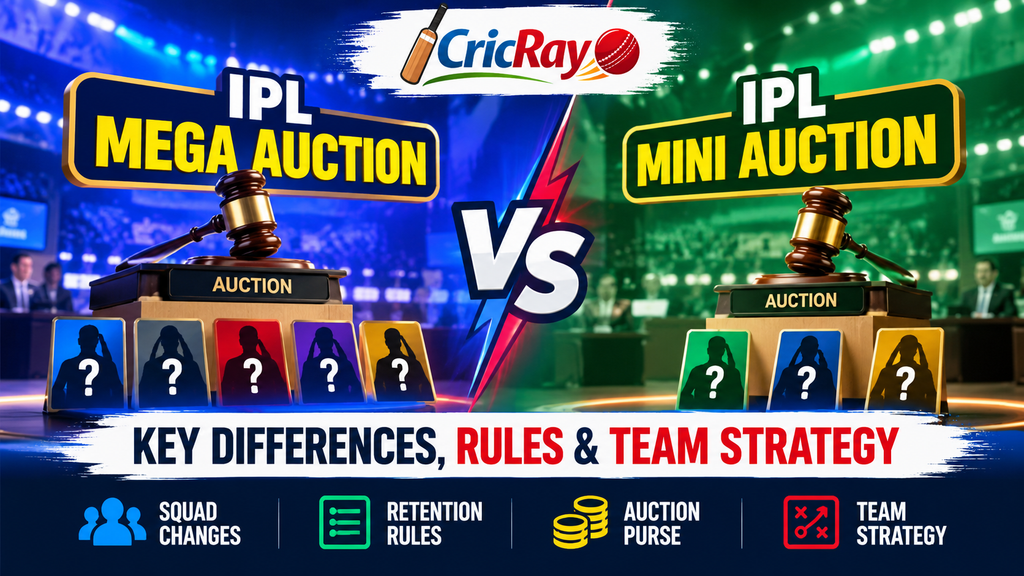
What Is an IPL Mega Auction?
A mega auction is a major player auction in which franchises have an opportunity to reshape a substantial part of their squads.
Before the auction, teams must follow the retention rules announced for that particular auction cycle. Players who are not retained may enter the auction pool, subject to the applicable regulations.
This creates an opportunity for franchises to build a new squad structure, sign players from other teams, and develop a fresh combination.
Key features of a mega auction
- Teams may need to rebuild a significant portion of their squads.
- Retention opportunities are limited by the rules announced for that auction.
- A large group of players can become available for bidding.
- Franchises must balance their remaining purse against the players they want to sign.
- Squad composition and long-term planning become important considerations.
The exact rules, retention limits, and available budget can change between auction cycles. Therefore, the rules for one mega auction should not automatically be treated as the rules for another.
What Is an IPL Mini Auction?
A mini auction is a smaller player auction in which franchises generally retain most of their existing squad and focus on filling vacancies or strengthening particular areas.
Teams may release players, assess their remaining squad requirements, and use their available purse to bid for new signings.
For example, a franchise might look for an additional fast bowler, a backup wicketkeeper, or a middle-order batter if those are areas it wants to strengthen.
Key features of a mini auction
- Most of the existing squad is generally retained.
- Teams focus on specific vacancies and squad requirements.
- The player pool is usually smaller than in a mega auction.
- The available purse depends on the franchise’s existing commitments and the applicable rules.
- Teams can make targeted changes without rebuilding the entire squad.
The number of players available and the exact auction rules depend on the regulations for that season.
Mega Auction vs Mini Auction: Key Differences
The following table provides a simple comparison of the two formats.
| Feature | Mega Auction | Mini Auction |
|---|---|---|
| Main purpose | Major squad restructuring | Targeted squad strengthening |
| Squad changes | Potentially extensive | Usually more limited |
| Retention | Subject to specific retention rules | Existing squad generally carries forward |
| Player pool | Usually larger | Usually smaller |
| Team strategy | Build a new squad structure | Fill gaps and improve the current squad |
| Budget | Depends on the announced salary cap and retention rules | Depends on the remaining purse and applicable rules |
| Player movement | Can involve substantial squad changes | Usually focuses on selected additions and releases |
| Planning | Long-term squad construction | Addressing immediate and upcoming needs |
Important: These are general differences, not a fixed rulebook. The IPL and its governing authorities can change auction regulations from one cycle to another.
How Do Retention Rules Differ?
Retention is one of the most important parts of the auction process.
To understand the specific rules, read our guide to IPL 2027 retention rules.
It determines which players a franchise can keep before the auction and how much of its available budget is committed to its existing squad.
Retention before a mega auction
Before a mega auction, franchises must follow the retention and player acquisition rules announced for that auction cycle.
The rules may specify:
- The maximum number of players a team can retain.
- The permitted combination of capped and uncapped players.
- The use of a Right to Match (RTM) option, if available.
- The amount deducted from the team’s auction purse.
For example, the IPL 2025 mega auction allowed teams a combined total of up to six retention and RTM opportunities, subject to limits on capped and uncapped players. These were rules for that particular auction cycle, not a permanent rule for every future auction.
Retention before a mini auction
Before a mini auction, franchises generally keep most of their existing contracted players.
Teams may release players they no longer need and use their available budget to sign replacements or strengthen particular positions.
The exact retention, release, and player registration procedures are determined by the regulations for the relevant season.
How Does the Auction Purse Work?
The auction purse is the budget available to a franchise for acquiring players under the applicable IPL rules.
You can also read our guide to the IPL 2027 salary cap to understand the salary structure and auction purse.
A team’s spending capacity depends on factors such as:
- The salary cap announced for that season.
- The cost of players already retained or contracted.
- The rules governing player releases and trades.
- Any specific adjustments prescribed for the auction.
Mega auction purse
In a mega auction, the franchise must plan its budget around the players it retains and the players it wants to acquire.
A team that retains several high-value players may have less money available for bidding. A team that retains fewer players may have more money available to build its squad through the auction.
Mini auction purse
In a mini auction, the available purse generally reflects the team’s existing squad commitments and any applicable adjustments.
A franchise with a larger remaining purse may have more flexibility to compete for players. However, it must still consider squad vacancies, player availability, and the rules governing the auction.
The key point: A larger purse does not automatically guarantee a stronger squad. Teams must use their budget to address their actual requirements.
How Do Team Strategies Change?
The two auction formats require different approaches to squad planning.
1. Squad building in a mega auction
A mega auction gives franchises a chance to rethink their team structure.
Teams may focus on:
- Identifying players they want to build their squad around.
- Finding a balance between experienced players and younger talent.
- Building a suitable combination of batters, all-rounders, and bowlers.
- Planning for the full tournament rather than a single playing XI.
- Managing the auction purse while competing for priority targets.
Because a large number of players may be available, franchises need to prepare for different bidding scenarios.
2. Squad building in a mini auction
A mini auction usually involves more targeted decisions.
Franchises may focus on:
- Replacing players who have been released or are unavailable.
- Finding backup options for key positions.
- Adding depth to the bowling or batting lineup.
- Strengthening areas that were less effective in the previous season.
- Using the remaining purse carefully.
A franchise with an established squad may only need a few additions rather than a complete rebuild.
Why Do Teams Release Players Before an Auction?
Player releases can happen for several reasons. A franchise may decide that a player no longer fits its squad plans, may need to create room in its budget, or may want to bring in a different type of player.
Other factors can include player availability, injury concerns, team balance, and changes in coaching or management.
A release does not necessarily mean a player performed poorly. It can simply reflect a franchise’s changing requirements.
Can a Mini Auction Change an Entire Team?
Yes, a mini auction can still lead to meaningful changes, even though it generally involves fewer squad changes than a mega auction.
A franchise may sign a small number of players who fill important gaps. Those additions can influence the team’s playing combination, backup options, and overall balance.
However, a mini auction does not automatically mean that every team will make major changes. Some franchises may make only a few signings, depending on their existing squads and available budget.
What Is the Role of the Right to Match (RTM) Card?
The Right to Match (RTM) option allows a franchise to retain an eligible player by matching a qualifying auction bid, when the auction regulations provide for it.
RTM rules can vary by auction cycle, including the number of opportunities available and the process for matching a bid.
For instance, the 2025 mega auction included RTM opportunities under its specific regulations. Readers should not assume that the same RTM rules will automatically apply to every mini auction or future mega auction.
Which Auction Format Is Better for Team Building?
Neither format is automatically better for every franchise. Each serves a different purpose.
A mega auction can offer a chance to make substantial squad changes. A mini auction can help a franchise strengthen an existing group without rebuilding most of its team.
The outcome depends on several factors, including:
- The quality of the available players.
- The franchise’s existing squad.
- Its remaining budget.
- The team’s specific requirements.
- The effectiveness of its recruitment decisions.
The auction format is only one part of building a competitive team. Player performance, team balance, coaching, and execution on the field also matter.
Is the IPL 2027 Auction a Mega Auction or a Mini Auction?
The auction format for a future IPL season should be confirmed through an official announcement from the IPL or BCCI.
The format matters because it determines how franchises approach retention, player releases, and squad planning.
Until the relevant regulations are officially announced, it is better not to assume that the next auction will follow the exact retention or RTM rules used in a previous cycle.
For updates on the upcoming auction, readers can follow CricRay’s IPL auction coverage.
Frequently Asked Questions (FAQs)
1. What is the main difference between a mega auction and a mini auction?
A mega auction allows franchises to make extensive changes to their squads, while a mini auction generally focuses on filling gaps in an existing squad.
2. Do teams retain players before a mega auction?
Yes. Teams follow the retention rules announced for that particular auction cycle. The number of players that can be retained and the applicable conditions may change.
3. Do teams keep most of their players before a mini auction?
Generally, yes. Franchises usually retain most of their existing squad and release selected players before bidding for new signings.
4. Is the auction purse the same for every team?
The salary cap is determined by the applicable IPL regulations, but the amount available to each franchise can differ depending on its existing player commitments and other permitted adjustments.
5. Can teams use RTM cards in every auction?
No. RTM availability and the number of opportunities depend on the rules announced for the particular auction.
6. Does a mega auction happen every three years?
Mega auctions have historically been associated with multi-year squad cycles, but the timing and format are determined by the IPL’s decisions and regulations. A fixed schedule should not be assumed for every future cycle.
7. Can a mini auction change a team’s playing XI?
Yes. Even a few new signings can influence a team’s playing combination, depending on the players acquired and the team’s needs.
Final Thoughts
Mega auctions and mini auctions are two different ways of shaping IPL squads.
A mega auction creates an opportunity for substantial squad restructuring, while a mini auction generally allows franchises to strengthen their existing teams through targeted signings.
Understanding the difference helps cricket fans follow player retention announcements, auction budgets, squad changes, and franchise planning with greater clarity.
For more IPL auction updates, rules, and cricket explainers, keep following CricRay.